Chapter 4 - Memories from My Childhood
DOLL FURNITURE: My father’s parents, Gangy and Dad Gangy (my names for them), always came over on Christmas day. This is a picture of the doll furniture that Dad Gangy built. The only surviving piece is the ironing board.
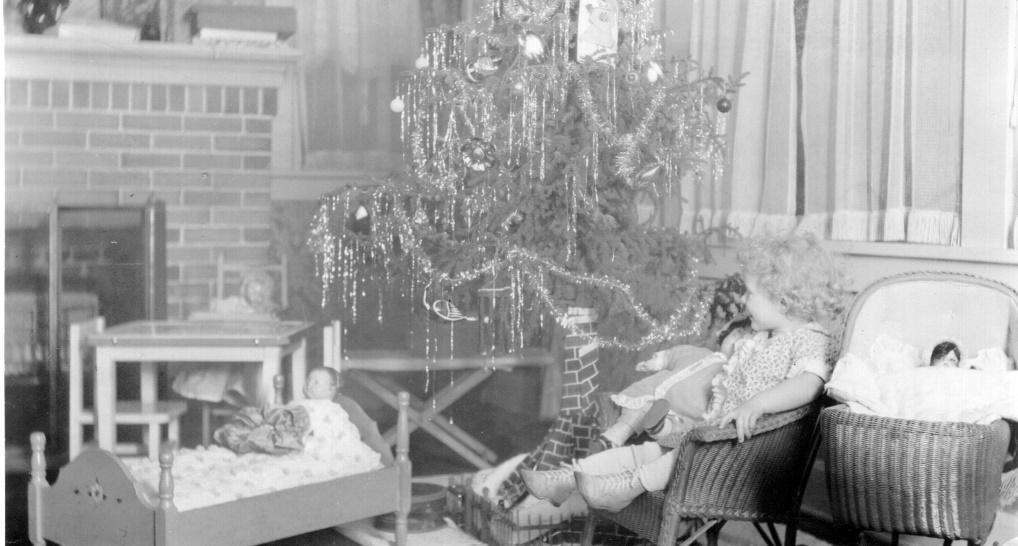
DOLL RESTORATION: On Christmas Morning I would find my dolls lined up on the sofa each wearing a new dress. I believe that after my bedtime Mother had stayed up until midnight making these garments. If any doll needed mending, a few weeks before Christmas she took them to a Doll Hospital for a new wig, or a new eyeball, or to have a dangling arm put back into its socket.
READING TO ME: On Sunday mornings Daddy would read me the funnies. I gave him instructions before he began: “Please do not read George Bungle or Maggie and Jigs but do read Tillie the Toiler and The Katzenjammer Kids and Dick Tracy. Evenings after dinner, he often read poems to me from A. A. Milne’s book When We Were Very Young. I had a list of favorites and they were always the same: “Disobedience”, “The Three Foxes”, “Rice Pudding”, “The King’s Breakfast” and “Jonathon Joe”. Occasionally I read these poems to myself and they still make me smile.
HOT OATMEAL ON COLD WINTER MORNINGS: Daddy would sit beside me at the breakfast table while he put sugar and milk on my oatmeal giving this advice, “Be sure to eat hot oatmeal around the edges of the bowl so you will not burn your mouth.” I still eat hot oatmeal around the edges of the bowl.
CLOTHES MY MOTHER MADE: In the 1920’s sewing machines were not electric. They were operated by rocking a treadle with both feet. This made the needle move in and out of the cloth making stitches much the same as a modern electric machine does.
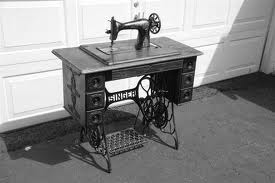
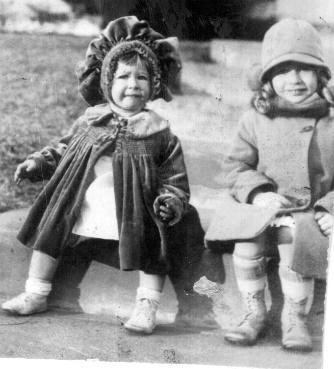
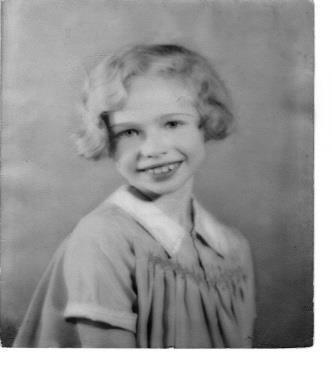
She made lovely dresses and sometimes put a finishing touch in the front which was called smocking. Smocking is a form of embroidery work that was popular in those days. She made Jean a blue velvet coat and hat. The hat has smocking around the rim. She made a dress for me when I started to school. It has smocking on the front.
THE ETIQUETTE LESSON: “There is a proper place and time to speak of a certain subject.” A lady was visiting my parents one evening. As I entered the room, I blurted out that the neighbor’s pet rabbit was going to have babies. I think that I offended this lady because she left the room crying. “What did I do?” I asked. In those days “having babies” was a subject that should never be mentioned when ladies and gentlemen were present in the same room.
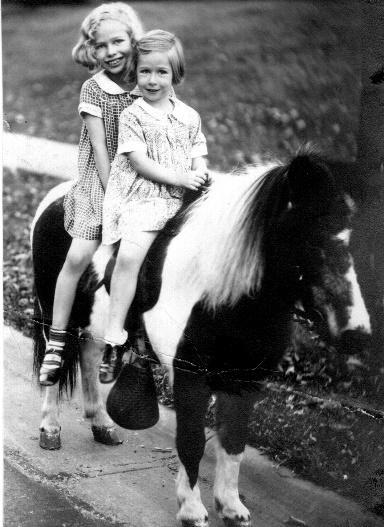 THE PONY PICTURE: A man leading a pony stopped in front of our house. He offered to take our picture if we would sit upon his pony. It sounded like fun so we sat upon his pony. We told Mother about this and she was very displeased. She knew that he would soon appear at our front door with the picture and ask her to pay for it. “Under no circumstances will I buy the picture,” she said. But when he showed up with the picture she liked it so much that she bought two copies.
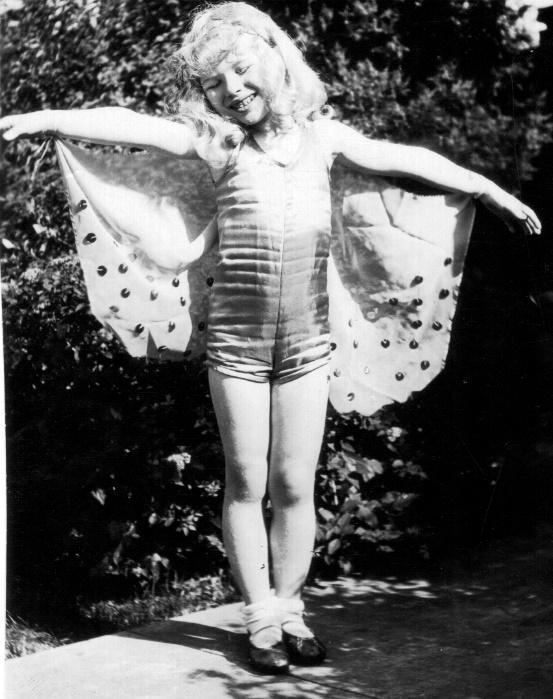
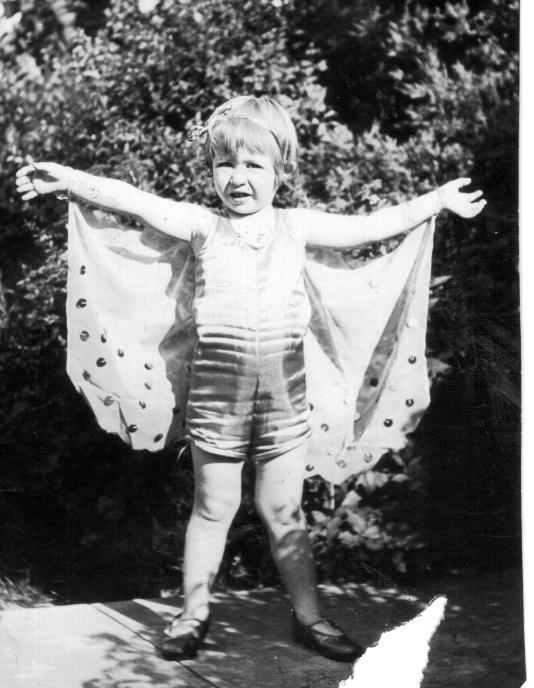
DANCING LESSONS: I took dancing lessons and danced in a recital as a Butterfly. Jean also wanted to be a Butterfly. So here is Butterfly 1 and Butterfly 2.
JEAN AND I SHARE A BEDROOM
Our Mother furnished the Middle Bedroom with twin beds. I remember the pink and white chenille bedspreads, the white chest of drawers and the dressing table with the white organdy skirt. A third bedroom in the house, called the Back Bedroom was used as a playroom or a guest room. If we needed to prepare the house quickly for company it became the “stash room”.
Life was good for us in those years. Occasionally, on warm summer evenings we would go for a drive and on the way home we would stop at a root beer stand. Root beer was five cents a mug for adults but children received a smaller mug of root beer free.
MOTHER LEARNS TO DRIVE: Mother wanted to able to take us to visit friends and relatives so she took driving lessons. One day she drove us to visit cousins. It was a cold winter day and as we made our way back home it began to snow. As we pulled into the driveway the snow was coming down so thick that she could hardly see. By the time she reached the garage she was totally distraught. She drove into the garage without opening the garage door. That was the last time she drove a car! But she found another way to get around the city. The Country Club streetcar line was short distance from our house. After she had paid the fare she could ask for a “transfer ticket” which would allow her to transfer to a bus or street car anywhere in the city. She took us with her sometimes and the three of us found our way about the city and always got home in time for dinner.
THE SYDENSTRICKER GRANDPARENTS: Grandparents were important people in my life. I spent a lot of time with Gangy and Dad Gangy. They taught me the satisfaction that comes from gardening. A snowball bush planted in their backyard needed water and they suggested that I pour a glass of water on the plant. As the bush grew larger and larger, they claimed that its marvelous growth was due to that single glass of water that I poured on it many months before.
They took pride in the city where they lived and followed the development of all things new to Kansas City. They took us to see the Nelson Art Gallery when it was under construction, also the new Power and Light Building and the Municipal Auditorium while they were in their beginning stages. If a new animal was purchased by the Kansas City Zoo, it became a reason to make trip there.
Gangy and I spent a lot of time together doing “girl” things. We had a Tea Party whenever I spent the day with her. She sang “Go Tell Aunt Rhody” to me and that is how I learned the words. We worked together in her backyard vegetable garden. She always wore a sunbonnet and an apron for this work. All her life she believed in being frugal and she was firm in this. She owned only two pairs of shoes, one for church on Sunday and one for everyday work. For her enjoyment she spent time with friends working on quilts. I still have the Wedding Ring Quilt that she made for me. She also had a sense of what to keep, such as newspaper clippings, memorial services for departed friends and family, graduation programs and Cecil’s school and military records. She kept all these in a scrapbook.
SCHOOL: The Border Star Elementary School on Wornall Road between 63rd Street and Meyer Boulevard was completed in 1929. In December of that year I became five years old and entered Kindergarten in the fall of 1930. My mother walked with me to school that day, met my teacher, Miss Quisenberry, then left me with my class mates. Miss Quisenberry suggested, for our own safety, that we learn our home address, our telephone number and how to spell our last name. I already knew my address and telephone number (I still remember it, Jackson 0800) but learning how to spell my last name (Sydenstricker) took a while.
My first grade teacher’s name was Miss Cleveland and she talked most of the time. I did not listen to every thing she said. If she talked too long my imagination would take over. Then I could put on my gossamer fairy wings and could fly out the school window, cruise around the school grounds and come back when I got ready. When I flew back through the window she was still talking. I did pass first grade though and entered second grade in the fall of 1932.
My second grade teacher was Miss Gordon, who loved to show us prints of famous paintings. Years later I saw these paintings in art galleries. She was wise to teach us art appreciation so early. But one day in class she mentioned a “chest of drawers” then went on to say that most people keep their clothes in a “chest of drawers”. Feeling completely left out, I began to cry because we did not have a “chest of drawers” in our house. We kept our clothes in a Chifferobe, which was our piece of furniture for storing clothes. (In these days we would refer to it as an armoire.) She listened while I explained. She accepted my explanation and I began to feel like I had the right furniture in my house.
While attending Border Star, I usually walked home for lunch then returned for the afternoon classes. A day came, however when Mother could not be at home during lunch time so she gave me money to buy a lunch ticket. I had never been to the cafeteria and did not know how to get there but when the cafeteria lined formed I joined it and followed the other children to the cafeteria. Once there I watched as the child in front of me put food on her tray. I did the same but the only food that looked good to me was one pickle and a glass of milk. When I reached the end of the line, a grown up person asked me if I was sure that was all I wanted. I said, “Yes”, and went to a table. That was a scary experience.
In the spring of 1933, I completed second grade at Border Star but that was to be my last year there. For my family, changes were about to take place.
Chapters
- From the Dark Years to the Golden Years
- Acknowledgements
- Prelude
- Dedication
- Background
- 1. Cecil and Myrtle
- 2. The House that Cecil Built
- 3. Running a Household in the 1920's
- 4. Memories from My Childhood
- 5. The Dark Days and Our Many Moves
- 6. 8920 Euclid Avenue
- 7. 4055 Hyde Park
- 8. Hillcrest Country Day School
- 9. 5110 Park Avenue
- 10. Medical Insurance and Social Security
- 11. 5614 Michigan Avenue
- 12. 311 East 43rd Street and the Pinafore Business
- 13. The War Years
- 14. The Years Following the War
- 15. The Golden Years
- Birth and Death Dates
- About the Author