Chapter 5 - The Dark Days and Our Many Moves
Beginning in 1924 and continuing well into the 1930’s our economy was undergoing vast changes. At first it was not apparent but gradually these changes would affect the entire country. It is easy now to look back and see that we were heading into trouble. The state of the economy had been so good for so long that some thought it would continue indefinitely.
There were signs that the economy was changing but those who should have recognized this did not want to acknowledge the changes or thought of the signs as adjustments that would correct themselves in time. Calvin Coolidge became President in 1924 and announced to the American people, “The business of America is business”. However in 1925 the Stock Market began a spectacular rise which bore little relation to what was really happening in the rest of the country. Even though it was apparent to some that the Stock Market was behaving peculiarly, caution was put aside. Between May of 1928 and September of 1929 the average price of stocks on the market rose 40%. Speculation was rampant. Trading mushroomed. What was thought to be a boom would turn out to be a bust. In March of 1928, Herbert Hoover became the new President and held views similar to those of Coolidge. Things were happening, though, that should have sounded an alarm. First, business inventories were three times larger than the year before because goods were not selling. Second, freight carloads were decreasing. Third, manufacturing had fallen off. Fourth, automobile sales and construction were down.
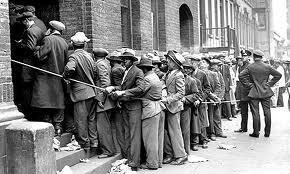
In the summer of 1929 a recession was beginning. Two months later, on Tuesday, October 29, 1929 the Stock Market crashed. That day is still known as “Black Tuesday”. Investment losses for the month were astronomical. In late 1930, the first bank panic occurred causing a run on banks. By 1932, ten thousand banks had failed. Stocks had lost 80% of their value. Another public run on banks resulted in wave of bankruptcies. Unemployment rose to 24%.
Bread lines and Soup Kitchens were forming in the cities.
Hoover tried to create measures to help the situation but popular opinion considered Hoover’s measures too little and too late. In 1932 Roosevelt defeated Hoover and said to the American people: “I pledge you, and I pledge myself, to a new deal for the American people”. In March of 1933, Roosevelt began his “First 100 Days” generating programs in an effort to bring about recovery from the Great Depression. Congress passed such programs such as the National Recovery Act (NRA) and the Works Progress Administration (WPA) to create jobs for the unemployed. A conservative Supreme Court declared these programs and others similar to them to be unconstitutional. This stymied the progress of his recovery programs, so Roosevelt resolved to liberalize the Court. There was great opposition by the Republican Party to a plan that would seriously liberalize the Court. He was accused of “Packing the Court” and under such pressure he offered an alternative. He allowed Supreme Court Justices over the age of 70 to retire with a lifetime pension. Some accepted this offer and this made it possible for him to select new Supreme Court Justices that were more supportive of his policies.
CHANGES AT HOME: The economic changes following 1929 were not felt in our household immediately. Life went on at our house as usual until 1933.
During the winter of 1931 my Mother was getting awfully fat. It was difficult for her to walk a long distance and to keep up with all the duties of her household. In February I found out why. A baby brother was on the way. He was born on Ground Hog Day, 1932.
My parents named him John but we all called him Jackie.
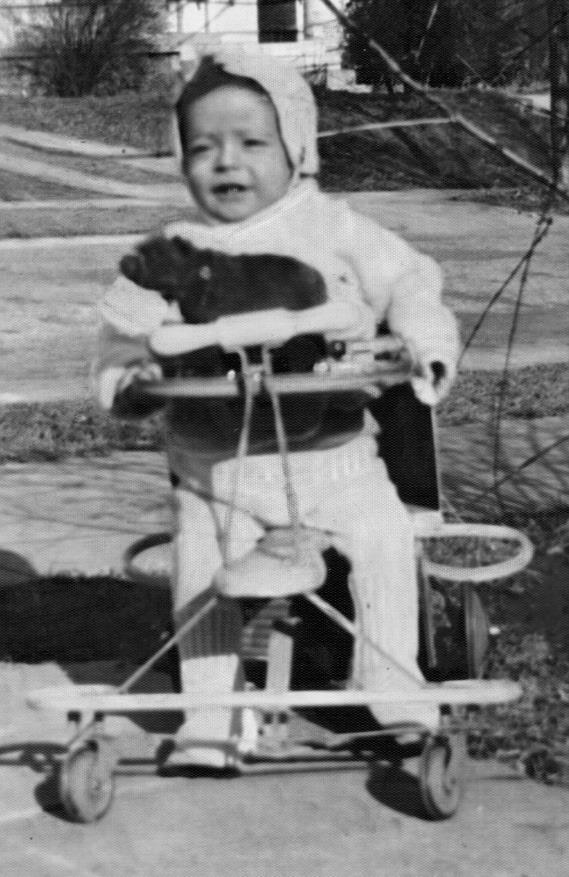
Now Mother needed outside help at home. A wonderful woman named Mary Dean Boyd came to live with us to help with his care and with the duties of a growing household. As months pass, Jackie grew and was able to get about the house in a “Kiddie Car”. People would notice his beautiful wavy Auburn hair. He seemed normal in every way with the exception of the color of his skin. He had yellow jaundice at birth which happens occasionally to babies. However, the yellow color of his skin did not fade. My parents consulted a doctor and learned that the jaundice should have cleared up by itself after two weeks but the doctor knew of nothing that could be done about this. During the exam he noticed that he had Jackie also had an enlarged spleen and liver. He said that surgery was not an option and added that it was likely that Jackie would never be able to walk. This was a frightening diagnosis.
As months passed Jackie became weaker. Finally on the night of May 10, 1933, Jean and I were sent to bed early. The doctor was there. Mother’s sister, my Aunt Gertrude, was there. There may have been other family members in the house standing by. In the morning we were awakened by Aunt Gertrude who told us that Jackie had died during the night. I do not remember seeing my Mother or Father the next day but they were likely overcome with grief and did not want us to witness that. I saw them the day of the funeral and at the burial. There is nothing more devastating to parents than the death of a child.
As children we were unprepared to realize the terrible grief they were experiencing. They shielded us from this and I do not recall expressions of anguish or appearance of tears. Months later I remember my Mother saying, “The only way to overcome grief is to work hard and keep your mind on other things”. But she never forgot Jackie. On the second of February of each year, she would say to anyone who would listen, “This is Jackie’s birthday.”
Daddy was dealing with this sadness in his own way. He never talked about this to me but I know his heart was heavy. This dashed his hopes for a son that would carry the Sydenstricker name forward.
But this was just the beginning of the bad news for our family. Just three months after Jackie died, they had to deal with grave financial difficulties. The Great Depression and its effects were devastating to many families and now it began to affect our family. The Baltimore Bank was one of the 10,000 banks that had folded so that Daddy was out of work! Further, his investment in the Azma-Tab went down the tubes along with the stock market collapse. As if that were not enough, we had a phone call while we were at dinner one Sunday and learned that his radio store had been destroyed by fire. With no money coming in, we could not make payments on our house or its furnishings. The house was going through foreclosure and they had to find another place to live. Neither parent was employed and no money was coming in. Unemployment insurance was not available in those days.
While my parents were finding ways to manage, they made arrangements for us to stay with grandparents. Later, when the grandparents brought us back to our home, we could see that all the furniture, pictures, toys, clothes had been carried away. Mother was sweeping the floors and Daddy was loading the car. I wanted to ask why but this did not seem a good time to ask questions. Mother and Daddy were working feverishly to finish clearing the house. I did not realize fully that this meant. Were we leaving this house and never coming back?
That evening we drove to another house way out in the country. There was furniture in that house but it was not ours. It turned out that this house was a summer vacation cabin. In the morning I could see other cabins up the hill. I was told that we were going to stay here just for the summer. We really had no other place to go.
Chapters
- From the Dark Years to the Golden Years
- Acknowledgements
- Prelude
- Dedication
- Background
- 1. Cecil and Myrtle
- 2. The House that Cecil Built
- 3. Running a Household in the 1920's
- 4. Memories from My Childhood
- 5. The Dark Days and Our Many Moves
- 6. 8920 Euclid Avenue
- 7. 4055 Hyde Park
- 8. Hillcrest Country Day School
- 9. 5110 Park Avenue
- 10. Medical Insurance and Social Security
- 11. 5614 Michigan Avenue
- 12. 311 East 43rd Street and the Pinafore Business
- 13. The War Years
- 14. The Years Following the War
- 15. The Golden Years
- Birth and Death Dates
- About the Author